
Chemistry · BGCSE / Organic chemistry
StructuredPast exam questionForm 5 · BGCSE
Study the reaction scheme showing reactions of different substances: starch is hydrolysed by dilute hydrochloric acid to glucose solution; yeast converts glucose to substance A and carbon dioxide; acidified potassium dichromate(VI) converts A to acid B; A and B react to give ester C.
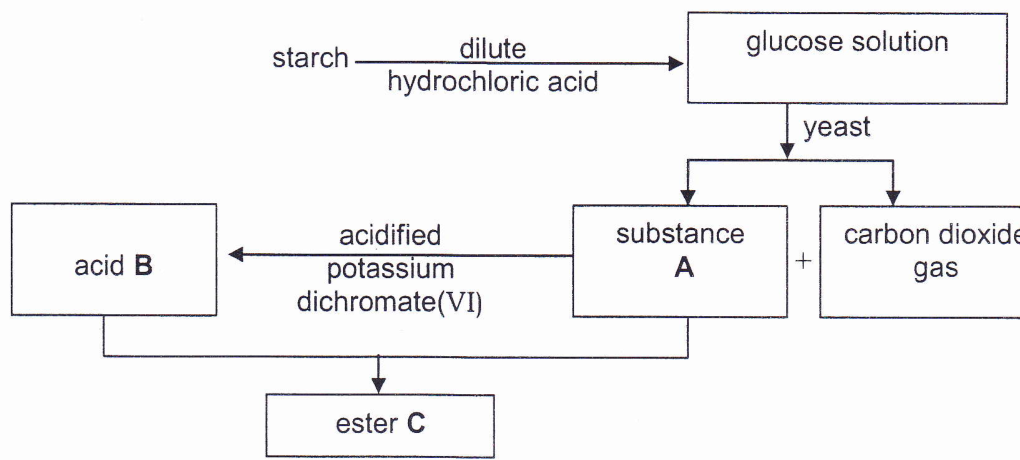
- aIdentify substance A. [1]
- bIdentify acid B. [1]
- cIdentify ester C. [1]
- dSubstance A is converted to acid B using acidified potassium manganate(VII). What is the role of potassium manganate(VII) in the reaction? [1]
- eDescribe the colour change observed during this reaction. [2]
You'll mark your own answer against the marking guide when you hand it in.
Source: BEC BGCSE Chemistry 2013, Paper 3, Question 2(a)
Report a problem
More like this
- The general formula of the alkanes is…
- Which reagent shows that a hydrocarbon is unsaturated?
- Ethanol can be made by…
- Crude oil is separated into fractions by…
- A man is working inside an enclosed well with a petrol generator running in order to power a lamp to provide light.
- A hydrocarbon has a molecular formula C₅H₁₂. The equation shows the reaction: C₅H₁₂ → C₃H₆ + C₂H₆. C₃H₆ undergoes addition polymerisation to form a m…
- State the conditions necessary for the production of ethanol by addition of steam to ethene.
- Ethanoic acid, CH₃COOH, can be formed by the oxidation of ethanol, C₂H₅OH, using acidified potassium dichromate.