
Chemistry · BGCSE / Redox and electrolysis
StructuredPast exam questionForm 5 · BGCSE
When an electric current is passed through the circuit shown for a set time, 0.54 g of silver is deposited on the cathode in cell I (silver nitrate). Cell II contains copper(II) sulphate and cell III dilute sulphuric acid. In cell III hydrogen is produced: 2H⁺ + 2e⁻ → H₂. (Ar Ag = 108, Cu = 64; 1 mole of gas = 24 dm³ at r.t.p.)
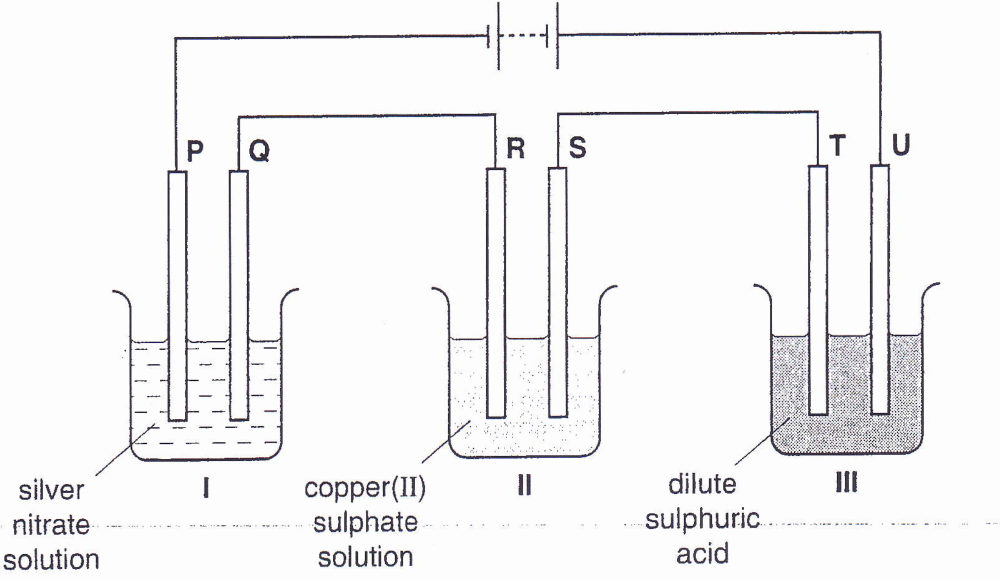
- aWhich electrode is the cathode in cell I? [1]
- bAt which electrode is copper deposited in cell II? [1]
- cWrite an equation for the formation of silver at the cathode in cell I. [1]
- dHow many moles of electrons were used to produce 0.54 g of silver? [2]
- eCalculate the mass of copper deposited at the cathode in cell II. [3]
- fCalculate the volume of hydrogen produced in cell III at r.t.p. [2]
You'll mark your own answer against the marking guide when you hand it in.
Source: BEC BGCSE Chemistry 2008, Paper 3, Question 4
Report a problem
More like this
- Oxidation is…
- In electrolysis, positive ions move to the…
- What is produced at the cathode in the electrolysis of molten lead(II) bromide?
- Concentrated sodium chloride solution (brine) is electrolysed with inert electrodes.
- Chlorine is produced by electrolysis of concentrated aqueous sodium chloride.
- A steady current of 15 A was allowed to flow through the electrolyte for 1 hour 30 minutes. The equation shows how chlorine is produced: 2Cl⁻ → Cl₂ +…
- Acidified potassium dichromate, K₂Cr₂O₇, also oxidises concentrated hydrochloric acid: K₂Cr₂O₇ + 14HCl → 2KCl + 2CrCl₃ + 3Cl₂ + 7H₂O
- The diagram shows a metallic fork electroplated using silver (silver anode, fork cathode, aqueous silver sulphate). 0.54 g of silver was deposited on…