
Chemistry · BGCSE / Metals and reactivity
StructuredPast exam questionForm 5 · BGCSE
Study the reaction scheme: aqueous CuSO₄ reacts with metal X to give iron(II) sulphate and brown solid Z; with solution Y it gives copper(II) hydroxide, which dissolves in excess Y to give a dark blue solution. Iron(II) sulphate with aqueous sodium hydroxide gives green precipitate P, which is oxidised to iron(III) hydroxide.
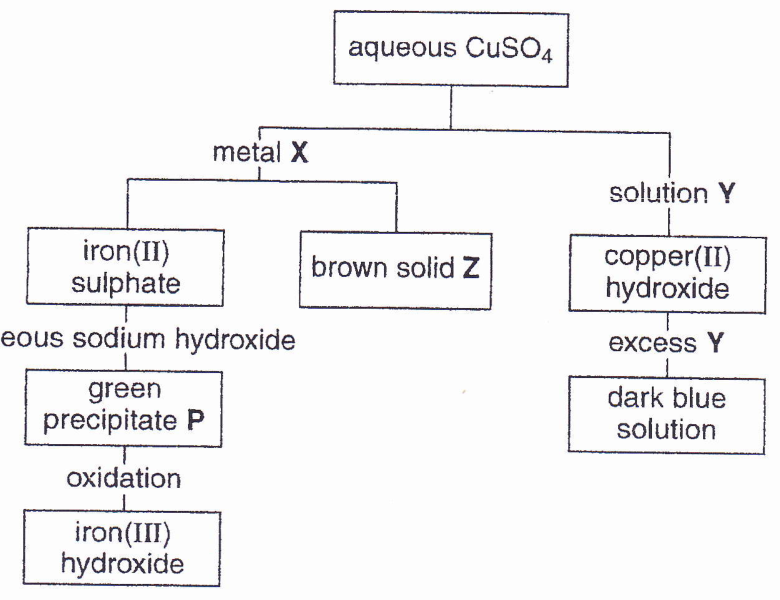
- aIdentify metal X. [1]
- bIdentify solution Y. [1]
- cIdentify green precipitate P. [1]
- dIdentify brown solid Z. [1]
- eName the type of reaction which occurs between metal X and aqueous copper(II) sulphate. [1]
- fWhat is the colour of iron(III) hydroxide? [1]
- gName the products formed when iron(III) hydroxide is heated. [2]
- hAcidified potassium manganate(VII), KMnO₄, was used to oxidise the green precipitate P to iron(III) hydroxide. State the colour change of the potassium manganate(VII). [1]
- iWhat happens to the oxidation state of iron during the oxidation? [1]
You'll mark your own answer against the marking guide when you hand it in.
Source: BEC BGCSE Chemistry 2007, Paper 3, Question 7
Report a problem
More like this
- Which metal is most reactive?
- Rusting of iron needs…
- Galvanising protects iron by coating it with…
- Which metals are mined in Botswana?
- Iron is extracted from its ore in a blast furnace by reduction with…
- Magnesium, copper and zinc are placed in dilute hydrochloric acid.
- In an experiment, metals Q, R, T and Z are reacted with aqueous nitrates of the metals (results in the table). Each of the metals has the same number…
- Metals are extracted from their ores by chemical reduction.