
Chemistry · BGCSE / Acids, bases and salts
StructuredPast exam questionForm 5 · BGCSE
Hydrochloric acid was added from a burette to 20 cm³ of aqueous potassium hydroxide containing a few drops of Universal Indicator. The graph shows the pH during the addition of the acid.
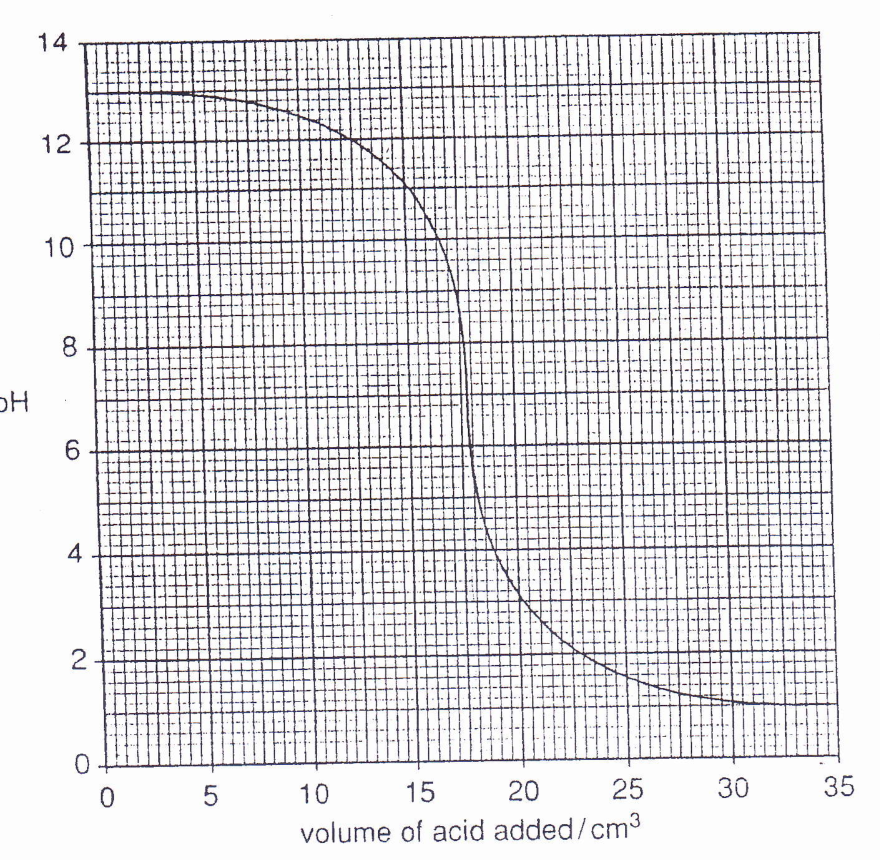
- aWhat was the pH of the potassium hydroxide at first? [1]
- bState the colour of the Universal Indicator when 10 cm³ of acid had been added, and when 30 cm³ of acid had been added. [2]
- cWhat volume of the acid was added to neutralise 20 cm³ of the alkali? [1]
- dComment on the relative concentrations of the acid and alkali. [1]
You'll mark your own answer against the marking guide when you hand it in.
Source: BEC BGCSE Chemistry 2005, Paper 3, Question 5(a)
Report a problem
More like this
- Acids produce which ions in water?
- Which gas is given off when a metal reacts with an acid?
- Which gas is given off when an acid reacts with a carbonate?
- Farmers add lime to soil to…
- Which salt is formed by sulfuric acid and copper(II) oxide?
- Carbon dioxide dissolves in water to form carbonic acid, H₂CO₃, which is a weak acid.
- To determine the energy change of a reaction, 25.0 cm³ of sodium hydroxide solution was poured into a polystyrene cup. Different volumes of hydrochlo…
- Ammonium sulphate, (NH₄)₂SO₄, is made by reacting dilute sulphuric acid with excess ammonia and then evaporating the solution. Dilute sulphuric acid …