
Chemistry · BGCSE / Bonding and structure
StructuredPast exam questionForm 5 · BGCSE
The structures of silicon(IV) oxide (each Si bonded to four O atoms in a giant network) and carbon dioxide (O=C=O) are shown. Silicon(IV) oxide has a high melting point whereas carbon dioxide has a very low melting point.
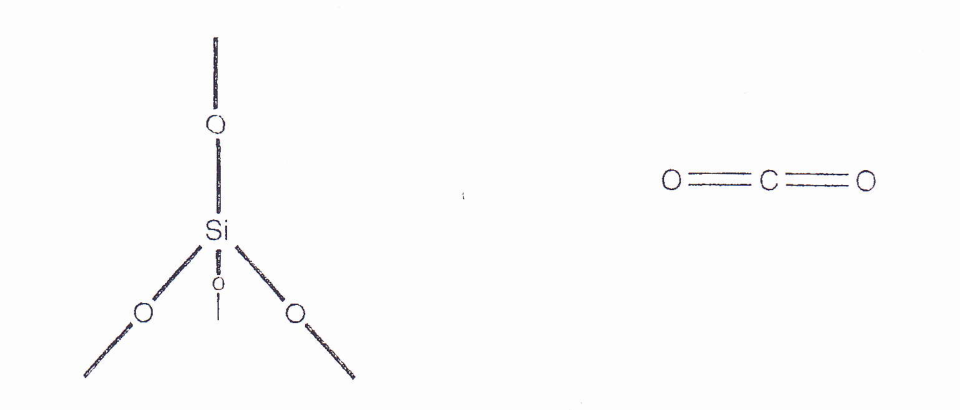
- aExplain this difference in melting points, referring to the structures of the substances and the bonding between their particles. [3]
- bDescribe a dot and cross diagram of one silicon atom bonded to four oxygen atoms (draw it on paper; inner shells not needed). [2]
You'll mark your own answer against the marking guide when you hand it in.
Source: BEC BGCSE Chemistry 2004, Paper 3, Question 1(c)
Report a problem
More like this
- The metals sodium and magnesium are found in period 3 of the Periodic Table. Sodium reacts with halogens to form sodium halides. The equation between…
- Carbon reacts with oxygen to form carbon dioxide.
- The structures of six substances are shown: A ammonia (NH₃); B sodium nitrate; C carbon dioxide (O=C=O); D nitrogen (N≡N); E potassium iodide; F sodi…
- Water is a molecular compound. It has intermolecular forces and intramolecular forces.
- Silicon(IV) oxide is an acidic oxide. It is similar in structure to diamond.
- Chlorine reacts with sodium: 2Na(s) + Cl₂(g) → 2NaCl(s). The diagram shows part of the lattice structure of sodium chloride.
- The diagrams represent the structures of two allotropes of carbon, X (a 3-D network of atoms each joined to four others) and Y (flat layers of hexago…