
Chemistry · BGCSE / Air, water and the environment
StructuredPast exam questionForm 5 · BGCSE
The flow chart shows a method of liquefying air: air → fine filtering → pass through potassium hydroxide → pass through anhydrous calcium chloride → compression and cooling → liquid air. The table shows the boiling points of some of the gases in air.
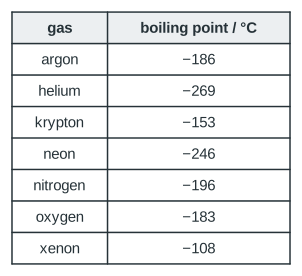
- aName the substance that is removed when air passes through potassium hydroxide. [1]
- bName the substance that is removed when air passes through anhydrous calcium chloride. [1]
- cExplain by reference to the behaviour of molecules why compression and cooling help to liquefy air. [2]
- dName two substances that will remain as gases when air is cooled to −200 °C. [1]
- eName the method by which the rest of the components of liquid air will be separated. [1]
You'll mark your own answer against the marking guide when you hand it in.
Source: BEC BGCSE Chemistry 2004, Paper 3, Question 2(b)
Report a problem
More like this
- About what percentage of air is nitrogen?
- Which test shows that a liquid is water?
- Acid rain is mainly caused by…
- Water containing dissolved carbon dioxide reacts with limestone, CaCO₃, forming hard water as shown by the equation. H₂O(l) + CO₂(g) + CaCO₃(s) → Ca(…
- Nitrogen dioxide is one of the pollutants found in car exhaust fumes.
- Pollutant gases such as carbon monoxide and oxides of nitrogen are produced by a car engine and are emitted through the exhaust pipe.
- Carbon dioxide, nitrogen and oxygen are all present in clean air.
- A student is given two samples of water: pure water, labelled Y, and rain water containing dissolved calcium hydrogencarbonate, labelled Z.