
Chemistry · BGCSE / Redox and electrolysis
StructuredPast exam questionForm 5 · BGCSE
The diagram shows the laboratory preparation of chlorine from manganese dioxide and concentrated hydrochloric acid. The gas passes through liquid Y, then concentrated sulphuric acid, and is collected by downward delivery. MnO₂ + …HCl → MnCl₂ + …Cl₂ + …H₂O
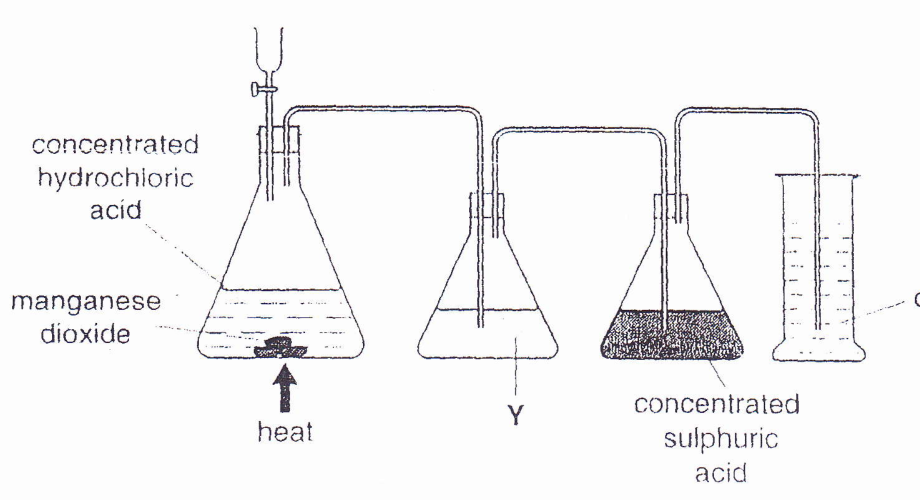
- aName the liquid Y and state its function. [2]
- bState the property of chlorine that makes it possible for it to be collected by the method shown. [1]
- cBalance the equation. [1]
- dShow how the oxidation number of manganese has changed during this reaction. [1]
- eExplain why this is a redox reaction. [1]
- fChlorine dissolves in water, forming chloric(I) acid, HClO, as one of the products. Construct the equation for the reaction of chlorine with water. [1]
- gState the action of chlorine on damp litmus paper. [1]
You'll mark your own answer against the marking guide when you hand it in.
Source: BEC BGCSE Chemistry 2004, Paper 3, Question 5
Report a problem
More like this
- Oxidation is…
- In electrolysis, positive ions move to the…
- What is produced at the cathode in the electrolysis of molten lead(II) bromide?
- Concentrated sodium chloride solution (brine) is electrolysed with inert electrodes.
- Chlorine is produced by electrolysis of concentrated aqueous sodium chloride.
- A steady current of 15 A was allowed to flow through the electrolyte for 1 hour 30 minutes. The equation shows how chlorine is produced: 2Cl⁻ → Cl₂ +…
- Acidified potassium dichromate, K₂Cr₂O₇, also oxidises concentrated hydrochloric acid: K₂Cr₂O₇ + 14HCl → 2KCl + 2CrCl₃ + 3Cl₂ + 7H₂O
- The diagram shows a metallic fork electroplated using silver (silver anode, fork cathode, aqueous silver sulphate). 0.54 g of silver was deposited on…