
Biology · BGCSE / Respiration and gas exchange
StructuredPast exam questionForm 5 · BGCSE
Yeast and glucose solution were mixed to make a suspension. The suspension was divided into three equal volumes and placed at 2 °C, 25 °C and 60 °C for 30 minutes. Fig. 4.1 shows the results: froth formed only at 25 °C.
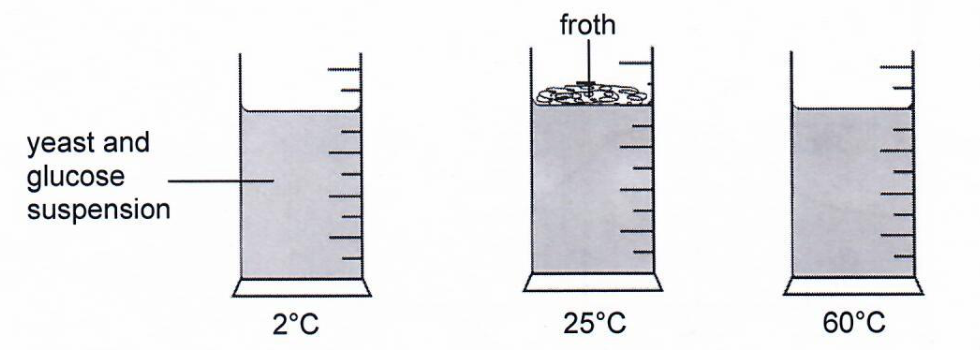
- (a) Explain the difference between results at 2 °C and at 25 °C. [4]
- (b) The suspension kept at 60 °C was then placed at 25 °C for another 30 minutes. Predict what will happen in this suspension. [1]
- (c) Explain your prediction. [2]
You'll mark your own answer against the marking guide when you hand it in.
Source: BEC BGCSE Biology 2019, Paper 3, Question 4
Report a problem
More like this
- What is the word equation for aerobic respiration?Multiple choiceBGCSE · Respiration and gas exchangeNot tried yet
- What is produced by anaerobic respiration in human muscles?Multiple choiceBGCSE · Respiration and gas exchangeNot tried yet
- Anaerobic respiration in yeast is used in…Multiple choiceBGCSE · Respiration and gas exchangeNot tried yet
- Which feature of the alveoli helps gas exchange?Multiple choiceBGCSE · Respiration and gas exchangeNot tried yet
- Fig. 3.1 shows changes in the concentration of lactic acid in the blood of an athlete over a period of 12 minutes: level from 0 to 3 minutes (P), ris…StructuredBGCSE · Respiration and gas exchangeNot tried yet
- During floods, soils may become water logged. This stops aerobic respiration in roots.StructuredBGCSE · Respiration and gas exchangeNot tried yet
- Distinguish between aerobic respiration and anaerobic respiration.StructuredBGCSE · Respiration and gas exchangeNot tried yet
- Fig. 7.1 shows a section through an alveolus and a surrounding blood capillary. With reference to labels A to F, discuss gaseous exchange. In your an…StructuredBGCSE · Respiration and gas exchangeNot tried yet