
Chemistry · BGCSE / Formulae, equations and moles
StructuredPast exam questionForm 5 · BGCSE
Another product of the corrosion of bronze is basic copper(II) carbonate, xCu(OH)₂.yCuCO₃. It is heated in the apparatus shown: CuCO₃ → CuO + CO₂ and Cu(OH)₂ → CuO + H₂O. When a certain mass is heated, 5.28 g of carbon dioxide and 1.08 g of water are formed.
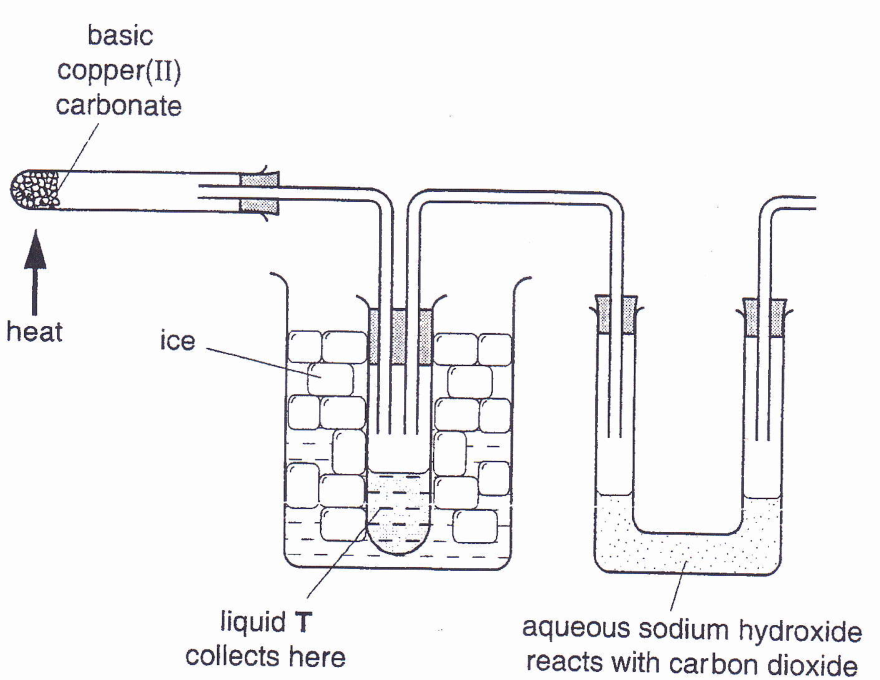
- aExplain why aqueous sodium hydroxide reacts with carbon dioxide. [3]
- bName the products formed when aqueous sodium hydroxide reacts with carbon dioxide. [2]
- cState the mass of 1 mole of carbon dioxide, and calculate the number of moles of carbon dioxide formed. [3]
- dState the mass of one mole of water, and calculate the number of moles of water formed. [2]
- eUse the number of moles of water and carbon dioxide to calculate the values of x and y, and write the formula of basic copper(II) carbonate. [3]
You'll mark your own answer against the marking guide when you hand it in.
Source: BEC BGCSE Chemistry 2008, Paper 3, Question 7(c)
Report a problem
More like this
- How many moles are in 36 g of water? (H = 1, O = 16)
- What volume does 1 mole of any gas occupy at room temperature and pressure?
- What is the concentration of 0.5 mol of NaOH dissolved in 250 cm³ of solution?
- Calcium carbonate decomposes when heated: CaCO₃ → CaO + CO₂. (Ca = 40, C = 12, O = 16)
- Answer the following.
- A 10 g sample of impure iron(II) sulphate, FeSO₄, was dissolved in water to make 250 cm³ of solution. Exactly 25.0 cm³ of the solution was titrated w…
- The equation for the production of ethanol by the addition of steam to ethene is shown (CH₂=CH₂ + H–O–H → CH₃CH₂OH). Bond energies (kJ/mol): C–H 412;…
- Petrol is a mixture of hydrocarbons. C₅H₁₂ is one of the hydrocarbons in petrol. It burns in oxygen: C₅H₁₂ + 8O₂ → 5CO₂ + 6H₂O. The table shows bond …